
How to Find Micro Influencers: Filters, Nano vs Micro & Platforms
To find micro influencers, choose a niche, platform, and explicit follower band before collecting accounts. Start with customers, brand mentions, and relevant posts, then use filtered search to build a shortlist. Review recent content and comments before deciding whom to contact.
Smaller creators can suit a focused test budget, but follower count alone does not establish affordability or audience fit. This guide covers nano versus micro tradeoffs, a copyable filter checklist, engagement vetting, and the difference between marketplace hire and a searchable database. For the broader discovery process, use how to find influencers for your brand.
Find smaller creators in Discover · Explore the influencer database
Micro vs nano influencers: ranges vary, so set your own filters
If you mainly need reusable content, the UGC creators for brands guide explains why production quality and usage rights matter separately from account size.
Nano and micro are common industry shorthand for account size. There is no single official taxonomy, and Creator River does not define a universal one.
| Size tier | Common shorthand | What the label leaves out |
|---|---|---|
| Nano | Roughly 1,000–10,000 followers | Recent reach, relevant viewers, fees, and production experience |
| Micro | Roughly 10,000–100,000 followers | Whether the audience and content match your specific offer |
Some sources instead call roughly 5,000–50,000 followers micro. An account near a boundary can appear in either category. On YouTube, use subscriber count for the size comparison. Record the actual minimum and maximum you want so colleagues and tools apply the same criteria.
For YouTube specifically, use how to find YouTube influencers to compare recent Shorts and long-form views alongside subscriber count.
For TikTok micro creators, use how to find TikTok influencers for native discovery and recent-view checks alongside your follower band.
For Instagram micro creators, use how to find Instagram influencers for Accounts-tab discovery and Reel/Insights checks alongside your follower band.
A follower band is a search boundary, not a rate card. Ask creators about fees for the format and rights you need before assuming a smaller account fits your budget.
Use the influencer rate calculator method to compare smaller creators' quotes without treating follower bands as prices.
When nano fits vs when micro fits
Nano creators may suit local communities, specialist hobbies, or early product tests. Fees can be lower and conversations more personal, although you may need more partners to reach enough relevant people. Coordinating samples, questions, and approvals still takes time for each partnership.
Micro creators may offer more reach per partner and more experience producing sponsored content, often at a lower fee than much larger accounts. Neither is guaranteed by size. For an SMB budget, compare a few candidates from each band against the same deliverable, then choose the mix your team can afford and support.
Why brands hunt micro and nano creators
A focused creator can explain a narrow use case in language customers recognize. A small cooking account devoted to compact kitchens may be more relevant to a countertop appliance than a broad lifestyle account. Look for that connection in actual posts and viewer questions.
Several smaller partnerships can also let a brand test different topics or presentation styles without committing its entire budget to one larger creator. Include creator fees, product, shipping, rights, and staff time when comparing the options.
Small does not automatically mean authentic, highly engaged, or profitable. Treat closer community ties as something to investigate, rather than a benefit proved by the follower count.
How to find micro influencers: a size-specific process
1. Lock the niche, platform, and follower band
Describe what the creator teaches, reviews, or demonstrates. “Beginner strength training at home” is more useful than “fitness.” Choose YouTube, TikTok, or Instagram based on the content format your customers use. Write down your minimum and maximum followers before browsing.
For example, a brand could start with TikTok creators discussing apartment workouts, between 10,000 and 100,000 followers. This is an illustrative search brief, not a budget or performance recommendation. Review results before deciding whether either boundary should change.
2. Use a few free discovery signals
- Customers and followers: inspect people already explaining or using your product.
- Mentions and tagged posts: follow relevant accounts back to their profiles and check their size.
- Niche hashtags and platform search: search customer questions and use cases, then review the creators behind useful posts.
- Competitor ads: inspect disclosed #ad or paid partnership posts to discover active creators in your category.
- Location, where relevant: search local communities for events or services, then verify where the audience lives.
Record the account, platform, follower count, and one relevant post. A competitor sponsorship shows prior commercial content; it does not disclose fees, sales, availability, or exclusivity. Stop collecting accounts once you need consistent size filtering more than another set of manual leads.
3. Move to filtered search when the list grows
A micro influencer database helps apply the same follower band across candidates. A marketplace can help you browse creators actively offering packages. Choose the route by how you want to contact and hire people.
In Creator River Discover, combine a plain-language niche query with platform and follower filters. Inspect the active filters before reviewing results. If the lower band returns few suitable accounts, try related topic wording or another platform; a database is not a complete list of every nano creator. Keep your budget requirements explicit.
Filter checklist brands can paste
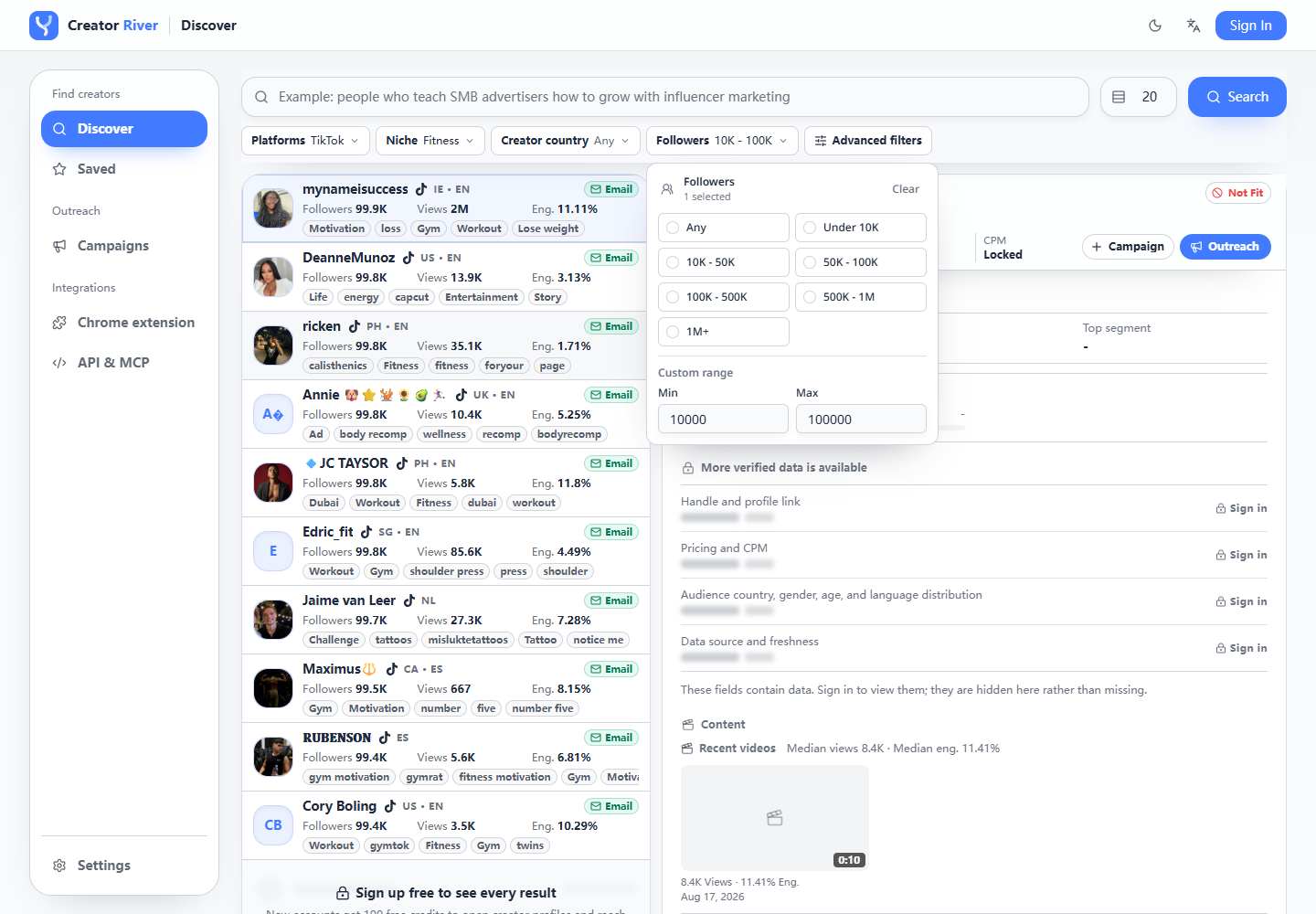
Live Discover filters, captured November 5, 2026. The custom range makes your size criteria explicit alongside the platform and niche.
Use this as a short search and review worksheet. The last three rows need human review; they are not promises of extra Creator River filters.
| Check | Set or record | Where to do it |
|---|---|---|
| Follower or subscriber band | Your explicit minimum and maximum | Discover follower filters |
| Platform | YouTube, TikTok, or Instagram | Discover platform filter |
| Niche and topic | Customer problem, use case, or specialist subject | Discover plain-language search |
| Recent activity and quality | Relevant recent posts and usable production quality | Review the creator's content manually |
| Contact path | Published business email and any stated partnership instructions | Creator profile and contact access |
| Audience and commercial fit | Needed audience evidence, availability, fees, and rights | Check on-platform or ask the creator |
Do not assume audience age, ethnicity, income, or fake-follower scoring is available because a tool offers follower filters. Ask for evidence when a missing detail determines whether the partnership makes sense.
4. Shortlist, vet, then contact
Keep candidates only when you can explain their relevance with a specific post and a plausible content idea. Mark unanswered questions separately. Review those candidates before opening a conversation, using the outreach guide when the shortlist is ready.
Vetting micro and nano creators: engagement over vanity
Smaller accounts can have uneven results. One successful post may dominate an average, while a high follower count can hide weak recent reach. Compare evidence from similar formats and topics:
- Recent typical views: inspect a consistent sample of comparable posts. A median helps keep one viral outlier from setting expectations. Record when you checked.
- Comment quality: look for product questions, relevant discussion, and creator responses. Repeated generic comments deserve a closer look, but do not prove fraud.
- Niche consistency: review content across roughly the last 30–90 days. Check whether the topic is sustained or appeared only in one popular post.
- Sponsored content: inspect how the creator integrates products and labels partnerships. Ask about conflicting commitments rather than inferring availability.
- Customer fit: consider language, use case, and viewer context. Attractive production alone cannot show that the people watching can use your product.
Separate short videos from long-form videos when judging typical reach. If public evidence leaves audience fit unclear, ask for recent platform analytics relevant to your brief. There is no universal engagement percentage that makes every small account suitable, and a past result is not a promise for your campaign.
Use the broader guide's vetting checklist for a deeper review before spending your creator budget.
What is a micro influencer platform? An honest taxonomy
A micro influencer platform is software for finding or hiring smaller creators. The label does not tell you whether you are buying a booking workflow, contact access, or a wider marketing service.
| Type | What you get | When it fits a micro budget |
|---|---|---|
| Marketplace hire, such as Collabstr | Creators listing services or packages; in-platform booking and payment, sometimes escrow | You want to compare available offers and book within that marketplace |
| Searchable database, such as Creator River | Filtered YouTube, TikTok, and Instagram discovery, profile access, business emails, and campaign outreach | You want to choose candidates and start direct email conversations |
| Full influencer-marketing suite or agency | Broader analytics and coordination tools, or managed services, depending on the provider | Your program needs capabilities or operating help that justify a subscription or retainer |
These categories overlap. Compare the specific workflow, included services, usage limits, and separate creator fees. A marketplace shows the creators offering services there; a database entry does not mean a creator has agreed to work with you.
Collabstr describes its marketplace and escrow payment workflow on its site, checked November 5, 2026. It is a category example, not a claim that every marketplace works the same way.
For Creator River's search-to-email model, see the influencer database overview, try Discover, and check pricing before scaling a list. The best micro influencer platform for your team depends on that workflow and your actual brief, rather than a universal ranking.
How Creator River helps you find micro influencers
- Open Discover. Choose a follower band for the nano or micro candidates you want to review.
- Add niche and platform criteria. Search a relevant topic and select YouTube, TikTok, or Instagram. Confirm the visible filters reflect your brief.
- Compare, then open promising creators. Review the available follower and performance evidence, inspect recent content, and decide which profiles merit closer attention. Every listed creator has a published business email on record; contact access uses credits.
- Add selected creators to a campaign. Send your pitch and track replies in its outreach list. The creator still decides whether to discuss an offer.
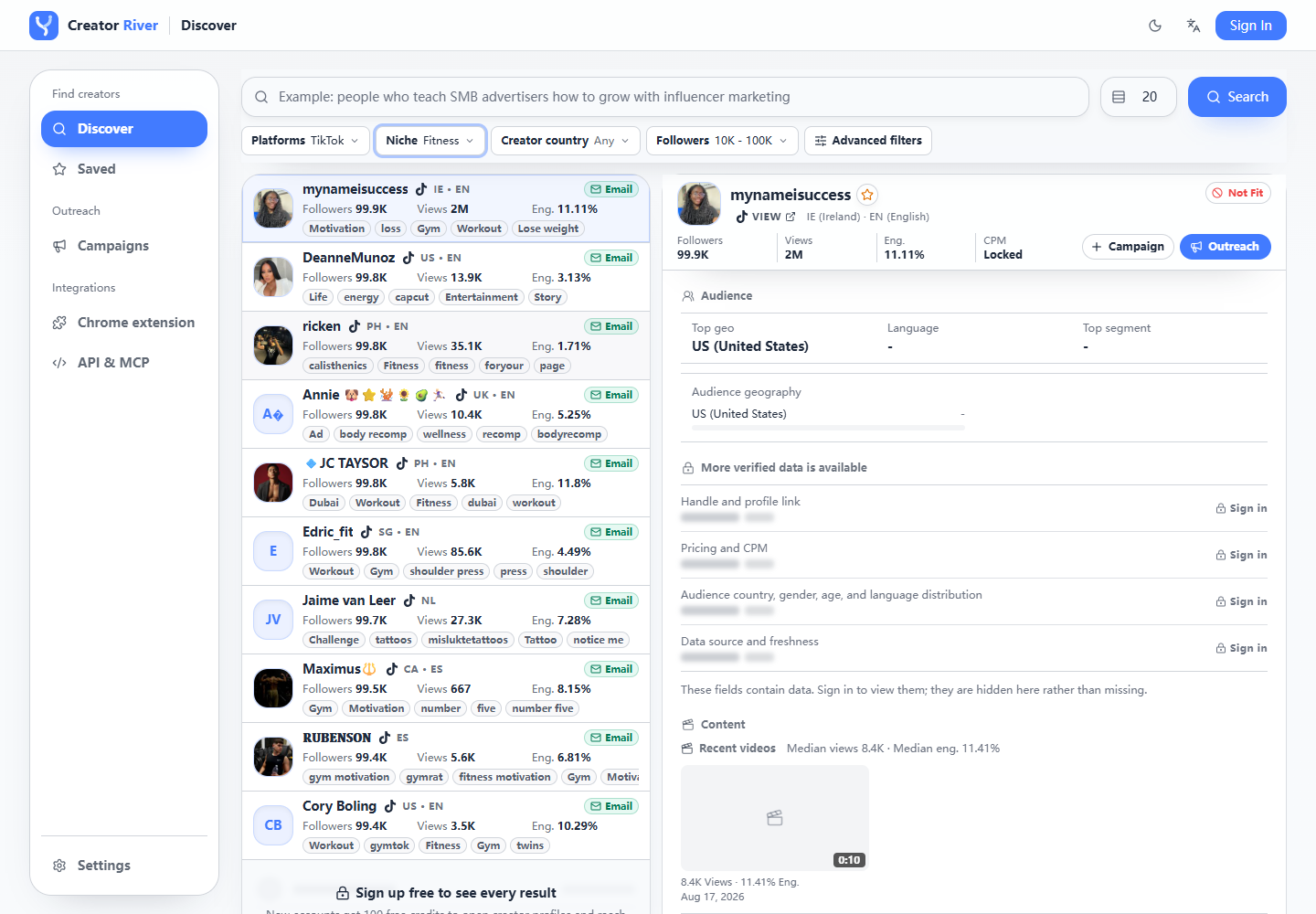
Live filtered results, captured November 5, 2026. Listings and metrics change; appearing here is not an endorsement or a performance prediction.
Credits cover access and sending
The live pricing page, checked November 5, 2026, lists a Free plan at $0 with 100 signup credits, 150 searches a day, and 100 free outreach emails a day. Opening a creator costs 0.5 credits; reopening is free. Contact reveal costs 0.2 credits, refunded on bounce. Emails beyond the free daily allowance cost 0.1 credits each.
Starter's annual option is about $15.83 per month, billed as $190 per year for 28,800 credits. Check current pricing before choosing a plan. Credits pay for access and sending capacity; budget separately for creator fees, samples, shipping, and any agreed content rights.
If you work through an agent, Creator River MCP supports the same workflow with shared credits and limits.
After the shortlist
- First email and follow-ups: use the influencer outreach guide, then campaigns to send and track replies.
- After an interested reply: follow how to collaborate with influencers for terms, briefing, and delivery.
- Broader discovery: read how to find influencers for your brand.
- Product and access model: review the influencer database.
FAQ
How do you find micro influencers?
Choose a niche, platform, and explicit follower band. Find leads through customers, mentions, hashtags, and disclosed competitor partnerships, then use database or marketplace filters to compare candidates. Vet recent content, typical views, and comment quality before contacting your shortlist.
What is the difference between micro and nano influencers?
Nano commonly means roughly 1,000–10,000 followers; micro commonly means roughly 10,000–100,000. Definitions vary. Nano partnerships may require more coordination for the same reach, while micro creators may offer more reach per partner. Confirm fees and fit individually.
What follower count is a micro influencer?
A common shorthand is 10,000–100,000 followers, but some sources use bands such as 5,000–50,000. There is no single official threshold. Set your own minimum and maximum in the search filters so the label does not decide your shortlist for you.
What is a micro influencer platform?
It is a tool for finding or hiring smaller creators. A marketplace centers on listed services and booking, a searchable database supports discovery and contact, and a full suite adds wider program tools. Check what the specific provider includes.
Marketplace vs influencer database: which is better for micros?
Choose a marketplace when comparing listed packages and booking within its payment process suits you. Choose a database when you want follower filters and direct outreach to selected creators. Compare software costs, contact limits, and creator fees using the same campaign brief.
How do I find nano influencers?
Use the same process with an explicit smaller follower band. Customer communities, tagged posts, and narrow topic searches can help uncover accounts missing from a database. Review content and availability manually; do not assume a tool covers every account in the nano range.
Does Creator River book influencers with escrow?
No. Creator River supports searchable discovery, business email access, outreach, and campaign conversations. It does not provide marketplace escrow booking. Agree on deliverables, creator compensation, and payment arrangements separately with the creator.
How much do Creator River credits cost vs creator fees?
Opening a creator costs 0.5 credits and revealing a contact costs 0.2 credits under the checked pricing. These charges buy product access, not a sponsored post. Creator fees depend on your separately agreed deliverables, rights, and other terms.
Find your next smaller creator shortlist
Open Discover and set your follower band, add a niche and platform, then review the evidence behind each candidate. Use the influencer database overview to understand the product and pricing to budget for access before reaching out.
Comparing AI search tools? The AI influencer discovery checklist helps you verify filters, contact access, and the claims behind a demo.